Exhibition
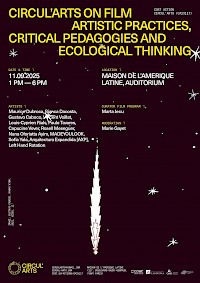
CIRCUL’ARTS ON FILM
Artistic Practices, Critical Pedagogies and Ecological Thinking
11th September 2025
Maison de l’Amérique Latine, Paris
Film Screening and Meetings with the artists
Artists: Gustavo Caboco, Nana Oforiatta Ayim, Rosell Meseguer, Arquitetura Expandida, Paulo Tavares, Left Hand Rotation, Capucine Vever, Luis Cyprien, Vincent Voillat, Sofia Yala, MadeYouLook, Maurice Dubroca, Bianca Dacosta.
Curator/Programmation Films: Marta Jecu
Moderation: Marie Gayet
The film program brings together case studies describing encounters between the human and the non-human and the new ecological relationships that emerge from these moments of hybridisation, which are performed through artistic practices and critical pedagogies. The case studies are situated primarily in African and Latin American cultural contexts – created by contemporary artists in video or film format.
Program: Maison de l’Amérique latine, Auditorium
1. Maurice Dubroca (France): Frans Krajcberg, Portrait d’une Révolte , 8 min. (Presented by Eric Darmon, film producer).
2. Bianca Dacosta (Brazil) : Interior da Terra , 17 min. (in the presence of the artist)
3. Gustavo Caboco (Brazil), Kanau'kyba , 11min.
4. Vincent Voillat (France), Le centre, c'est les pierres, vidéo sur smartphone, 8 min. HD. 2020
(in the presence of the artist)
5. Luis Cyprien Rials (France), Ba bel , 2023, 12 min
6. Paulo Tavares (Brazil), Non human Rights , 4min
7. Capucine Vever (France), Ô Diryanké , Dérives Alpines , 19min.
8. Rosell Meseguer (Spain), SLHS Tamarugal , Total: 26 min. (in the presence of the artist)
9. Nana ONana Oforiatforiatttaa AyimAyim (Ghana), Nowhere Else ButNowhere Else But HereHere, 24 min, 24 min
10. MadeYouLook (Molemo Moiloa and Nare Mokgotho) (South Africa), MenaganoMenagano, 5 min., 5 min.
11. Sofia Yala (Angola), Sofia Yala (Angola), Constellation of Dust, Slideshow (5 min.), Slideshow (5 min.)
12. AArquitetura Expandida (Colombia)rquitetura Expandida (Colombia),, La Comunidad dela PalaLa Comunidad dela Pala, 20 min. , 20 min. (in the presence of the artist)
13. Left Hand RotLeft Hand Rotation (Spain/Portugal), Sem manifestaçãoSem manifestação (5 min), (5 min), Bye, Bye and Thanks for Bye, Bye and Thanks for nothingnothing (5 min) , (5 min) , Tigre e YaguareteTigre e Yaguarete, (27 min)., (27 min).
Films Presentation
1. Maurice Dubroca (France) : Frans Krajcberg, Portrait d’une Révolte, 8 min. Production Mémoire Magnétique, (français). Présentéd by Éric Darmon
A Jew of Polish descent, "naturalized" Brazilian in the 1950s, Frans Krajcberg had an extraordinary life. Crushed by the Second World War, in which his family perished, he "wanted to escape from humanity" in the immediate postwar period. In contact with Brazilian nature, his work is a cry against the destruction of nature and life. Today, his work has acquired a universal and global dimension. From the Amazon to the state of Bahia, via Minas Gerais, from Brazil to France, we follow Krajcberg in the places where he lives and works. But through the portrait of a man, it is above all the story of a destiny and the story of a revolt that the film tells. Among these awards: First Grand Prize for Militant Art Film FIFAP - Maison de l'Unesco - Paris 2004, Prize for Best French-Language Film FRAPNA Environmental Film Festival - Grenoble 2005
LINK ENTIRE FILM: http://www.memoiremagnetique.com/?page_id=370
2. Bianca Dacosta (Brésil) : Interior da Terra, 17 min. (Brésilien sous-titré français) -
The soil is a magical dust that has the power to store and preserve buried memories. The overlapping layers speak to each other and tell of the transformation of the memories of this territory into resources. Layer upon layer, extracting the richness of the earth is erasing its memories.Like an exploration from the sky to the bowels of the forest, the film is a journey that leads through the strata into the soil to reveal the layers of buried history. The film demonstrates the depths of political issues in a historical and current account of the destruction of the Amazon rainforest and its indigenous Mura people. (texte Bianca Dacosta)
3- Gustavo Caboco (Brésil), Kanau'Kyba, 2021, 11' – film d’animation, commande pour la 34ª Biennale de São Paulo.
Kanau'Kyba signifie « Chemins de pierre » en langue indigène Wapichana, dont les artistes sont les ancêtres. Le film s'inspire d'une immense météorite (bendegó), conservée au Musée national de Rio de Janeiro et représentant un ancêtre des populations indigènes. Lorsque le musée a été presque entièrement ravagé par un incendie en 2018, la météorite a été l'un des objets ayant survécu. L'animation montre les paysages de pierre sous leurs multiples formes au sein des systèmes de croyances et des territoires indigènes : des pierres terrestres de la Serra da Lua, du Roraima, du territoire indigène de Canauanim, aux pierres du Paraná et de Kurityba, et enfin au musée, la pierre porte en elle la mémoire indélébile de la culture indigène.
4-Vincent Voillat (France), Le centre, c'est les pierres, vidéo sur smartphone, 8 min. HD (français sous-titre anglais)
Le centre c’est les pierres unfolds like a nocturnal incantation. A single beam of light brushes over fragments—stones and bodies merging in the dark—as if awakening their hidden pulse. The film opens and closes with a blurred moon, a breath between apparition and disappearance. A voice speaks of exhaustion, desire, and escape, yet gradually dissolves into the stones themselves, confessing their sovereignty. They stand as lovers and witnesses, guardians of forgotten struggles, murmuring a language older than memory. The camera lingers until vision falters, until forms turn to constellations. What remains is a trance of stone, a passage where the human becomes porous, swept into mineral time. In this hypnotic cycle, the centre is no longer us but the stones—silent, immovable, and infinite companions of our vanishing.
5-Louis-Cyprien Rials (France), Babel, 2023, 12 min
In this long sequence shot of a landscape of rocks and deserts, Louis-Cyprien Rials connects the myth of Babel—the Tower of Babel, a towering structure seen as a means of connecting heaven (the divine world) to earth and its diverse voices, a place of tolerance—to contemporary discourse, where artificial intelligence and transhumanism appear as new Towers of Babel. Accompanied by a soundtrack composed by Romain Poirier, the work presents excerpts from the Book of Genesis, translated and read by AI programmes (DeepL and ElevenLabs). This choice of narrators highlights the parallels between ancient myth and modern technologies, where humanity's quest for perfection through virtual and biological augmentation echoes the ambition of the builders of Babel. Rials' work captures the tension between transcendence and destruction, inviting viewers to reflect on the price of pride in a world where the tools to build new Babels are already within our reach.
6- Paulo Tavares (Brésil), Non-human Rights, 4min et Trees, Vines, Palms, 2mn. (Espagnol et sous-titres anglais)
In his two films NonHuman Rights (2012) and Trees, Vines, Palms and Other Architectural Monuments (2013), Paulo Tavares raises the question of territory and the notion of nature having rights on the same footing as human beings from a philosophical and historical perspective. NonHuman Rights draws on the thinking of Michel Serres and his book Le Contrat naturel (1990), in which the philosopher proposes replacing the ‘social’ contract with a ‘natural’ contract, open to forms of non-human legal personality. The world also has rights. In Trees, Vines, Palms and Other Architectural Monuments, he takes us on a journey to a now-vanished Xavante village, where plant species continue to tell a story, equivalent to architectural ruins, but living and not dead. Can trees, vines and palms be considered historical monuments? Is the forest an ‘urban heritage’ resulting from non-Western forms of development?
7- Capucine Vever (France), Ô Diryanké, 21min, Dérives Alpines, 19 min (sous-titres français)
Ô Diryanké is an ode to the sea, created and performed by the Senegalese singer and old fisherman Thiarwa, from the Bay of Dakar. Ô Diryanké (Oh the great lady) is the affectionate nickname that Thiarwa has taken to giving to the ocean. The ocean, which responds to Thiarwa, is the central character of the film. Its movements, its undertows, its trafficking, its voice and its memory accompany us in its immensity. The ode tells the story of the migrant ships swallowed by the sea, but also recalls the songs of the slave ships that sailed between the island of Gorée, once one of the most important slave citadels. The film shows the pollution of the sea and how the rising waters impact this island. The story told by Thiarwa reveals the sea as a feminine presence to which the population has established an intimate animist relationship.
Dérives Alpines captures the perspective of the mountains in a place once dominated by tourism. The Alps, slowly melting due to global warming, are presented not as a solid, inert block, but through their own transformations, fragility and internal movements, revealed by innovative cinematographic techniques.
8- Rosell Meseguer (Espagne), SLHM Tamarugal, 15,37mn, 2004-2024 (textes écrits anglais et espagnol) Artiste présente.
From 2006 to 2016, with the support of institutions such as the Chilean Ministry of Culture, Arts, and Heritage and the Spanish Ministry of Culture, Rosell Meseguer traveled throughout the Norte Grande region of Chile, Bolivia, Peru, Argentina, and southern Spain. During these trips, she made audiovisual recordings and photographs and began to build an archive of the mining industry, from saltpeter mining in the 19th century to present-day operations. Based on her experience of descending into a mine at the age of seven in Cartagena, Spain, the artist established a dialogue between the mining history of the southern Iberian Peninsula and mining in Chile, Bolivia, and Peru, in locations from which minerals were shipped to Europe. Audio and images intertwine two continents and four countries, connected by history and power, reflecting how the problems of the past extend to the present.
9- Nana Oforiatta Ayim (Ghana), Nowhere Else But Here , 2012, 24min, (anglais)
As an extension of the ANO cultural platform, artistic development and cultural leadership programmes, Nana Oforiatta-Ayim's film ‘Nowhere Else But Here’ (2012) is presented as a travel diary accompanied by the director's personal reflections on the cultural reality of Africa. Like an uninterrupted road trip, the film travels along roads, crosses landscapes and cities, meets inhabitants, captures the pulse of the dynamism of the populations, while distancing itself from the dominant discourse. From one place to another, Nowhere Else But Here speaks of the permeability of space and the reappropriation of representations of his country, with a certain sense of improvisation.
10. MadeYouLook (Molemo Moiloa and Nare Mokgotho) (Afrique du Sud), Menagano, 5 min.
This film comments notions of land, belonging and repair, grounded in the history of Bokoni, a region of northern South Africa where MADEYOULOOK have been conducting research for the past 6 years. This history is one of dispossession and loss, but also of return, repair and recovery rooted in the relationship of local populations with the land, and ecological knowledge and spiritual connection to the place. The film takes as its point of departure, a recent sound installation by MadeYouLook (Mafolofolo: place of recovery) commissioned by Documenta 15, that considers how sound and oral history serve as the basis of a South Africa tradition of landscape aesthetics. It was a choice of not including subtitles.
11- Sofia Yala (Angola/Portugal) The Body as an Archive, Slideshow, 2025, (1,49mn)
This work is constituted of 3 series of works, transposed for this event in a slide show. In ‘Type here to search’ Yala digs through the heaps of family archives to understand her family’s path. In long conversations with family members she realized that information is permanently lost and fragmented and she pleads for the recognition of the importance of black family albums. In ‘Historical Contextualisation’ she tells the story of her grandparents, who's archives she found in a suitcase. Both grandparents were cruise ship workers between the '40s and '80s in Portuguese and international companies, marked by hard labor and racial discrimination. Her grandfather, began to connect with the struggles for independence taking place in the Global South, particularly on the African continent, while maritime workers formed a network to send and receive documents, letters, books, and manifestos—any intellectual or physical tools that could aid in the liberation processes. Her grandpa, who was reading the censored "Partido Comunista" newspaper was imprisoned multiple times by PIDE. “The Body as an Archive“ shows photographs of her family, that reveal typical representations of Angolan families throughout the '50s to the '90s and traces their movements abroad and the formation of the PALOP communities as a background.
12 Arquitectura Expandida (Colombia), La Comunidad de la Pala, 20 min.
Our Utopias (2024). 7.06 min et Everyday Violence (2024). 6.20 min (textes en anglais et espagnol)
'Utopia is built collectively. Utopia is built within territorial scenographies that shape collective rituals. It resides in the performative power of bodies coming together to instigate our own narratives of rights against the multiple forms of violence that affect us'. “The Shovel Community” (2021–2024), Arquitetura Expandida's project which facilitates networks of action and collective care among artists and activists in the rural-urban edges of Bogotá, had different manifestations, among which the collective construction of Antennas: mobile structures that are meant to coagulate the community and empower them for common action. The compilation of reels, published on social media by grassroots organizations within this community, denounces the various forms of violence they face on a daily basis. A rap track led by Casi Nadie, created collectively with participants of the Comunidad de la Pala in 2021, transforms the shovel (la pala) into a symbol of this community's lives.
13 . Left Hand Rotation (Spain/Portugal), Sem manifestação, Bye, Bye and Thanks for nothing, Tigre e Yaguarete, 27 mn
"Bye and thanks for nothing" is an intervention against the massive arrival of cruise ships to São Miguel Island (Azores), in collaboration with the Habitat Açores collective and participants in a workshop on civil disobedience. Vintage images (photographs, prints, paintings)show the negative ecological impact of the 60 cruise ships bringing 76.000 tourists in only 6 months: polution of sea and air, lack of acces to public spaces and public transportation for the inhabitants. The postcard with information were dispayed on a free postcard holder in the port.
"Without Expression of Interest, Modern Slavery" addresses the new exclusionary immigration policies in Portugal. They used the original designs of Portuguese slave ships—which transported millions of slaves for centuries—to build boats that they floated in the fountains of Lisbon's historic center, in a parish with the largest non-EU immigrant population, which were recently refused residence certificates, hindering access to fundamental rights.
'Tigre e Yaguarete' (Tiger is Jaguar) comments on the Paraná Delta (Argentina), filled with luxurious country resorts, which promote coexistence with nature, but actually destroy it. Tigre's downtown is clean and touristy, while nearby, a group of women recycle plastics in a neighborhood without garbage collection or running water. And in the interstices of the cannibalistic real estate expansion, the Punta Querandí indigenous community cultivates a seed of resistance.