Exhibition
From my Window. Framed Nature
A Selection of recent Romanian painting
November 2025
Centro de Arte de Ponte de Sor, Portugal
An event of Palacio Fronteira (Casas Fronteira e Alorna Foundation), Lisbon
and the Romanain Cultural Institute Lisbon.
Group Exhibition
Artists:
Marcel Lupșe, Ștefan Pelmuș, Brândușa Bontea, Relu Bițulescu, Elena Flora Răducan, Constantin Pacea, Emanoil Mazilu, Daniela-Elena Grapa, Laurentiu Midvichi, Marinela Mantescu.
Curator: Marta Jecu
PRESS RELEASE
Nature is an image of the environment as we perceive it. It reflects the interplay between inner and outer nature, as well as the cultural and social codes through which we understand the space we inhabit.
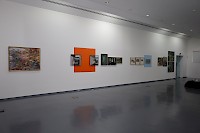
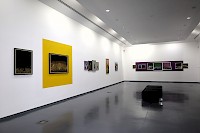
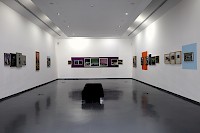
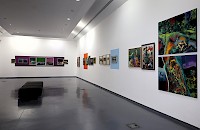
This selection of works by Romanian artists explores how nature is not merely represented, but perceived through the lens of the domestic environment. None of the works depicts wild, untamed vegetation; instead, we encounter a domesticated, interiorised nature. The focus is therefore less on nature itself than on the perspective of the viewer observing it from within. The way we look at nature reveals our sense of social belonging, while this collection explores how urban individuals in contemporary Romania relate to their environment.
Architecture invariably establishes a relationship between nature—as an untameable entity—and the interior from which it can be observed or cultivated, in gardens and herbaria. This exhibition brings together works that engage not with wild nature but with its artificial representations. The nature depicted in these paintings resembles an image we project onto the world rather than the natural environment we encounter directly. The exhibition explores nature as a metaphor for how social reality is perceived, as well as for the observer’s position and relationship with the world. These fragments of nature become intimate portraits of the search for identity, both individual and collective.
As illustrated by Lisbon’s Palácio Fronteira, where nature and architecture merge into a theatrical composition, the various styles adopted by palace gardens throughout history reveal how every garden, within a built environment, constitutes a form of “museification” of nature, imbuing it with cultural meanings. In some gardens, nature appears wild; in others, it is organised according to structured patterns that reproduce urban configurations; while others evoke lush environments, suggesting immersion in unfamiliar cultures and worlds.
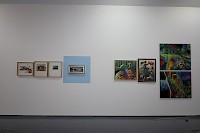
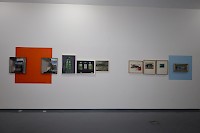
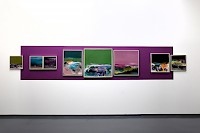
Although all the works presented are recent (2017–2025), they draw on styles and representational codes that have endured over recent decades. In Danielei Grapa’s Eight Landscape Variations, the artist constructs an apparently external landscape through shifts between different personal states of mind. Marcel Lupșe’s works evoke botanical illustration and an ancestral form of knowledge—natural medicine—which remains an important part of Romanian vernacular culture. Their precise recording of plant characteristics through rigorous technical compositions recalls established conventions of scientific representation, dating back to nineteenth-century expeditions. Ștefan Pelmuș approaches nature as it appears when laid out on a table: transformed into physical or spiritual nourishment and composed of essential elements such as wine, bread, water and fruit. His paintings evoke a medieval imaginary, with references to miniatures and the codified imagery of heraldry. In Constantin Pacea’s Patio de Sevilla, we enter a domestic world that simultaneously opens onto the dream of an unknown yet safe and protected universe. The image establishes a bridge to the Iberian world of open architectural spaces, which has long held a particular fascination in the Romanian imagination.
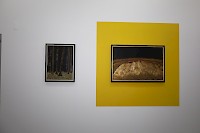
In Laurențiu Midvichi’s works, acidic colours and the freshness of an aesthetic associated with the 1980s evoke the beginnings of the digital age, when natural and artificial worlds began to merge. Relu Bitulescu’s landscapes, with their dark, earthy nature and nocturnal scenes, evoke legends and ancestral landscapes. The shadowy interiors of Elena Răducanu, where nature enters the home, recall the Romanian rural environment and its natural materials, particularly raw wood.
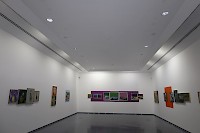
The representations of nature brought together in this exhibition, hosted by the Arts and Culture Centre of Ponte de Sor, reveal less a distinctly “Romanian landscape” than the diversity of cultural styles and representational codes currently practised in Romanian art. How landscapes have been and continue to be experienced, observed, reproduced and disseminated tells us much about how individuals—both painters and viewers—perceive their place in the world.
Some works belong to the legacy of late abstract expressionism, others adopt a more conceptual approach, while others are decorative. All, however, reveal the enduring symbolic significance of nature within Romanian culture.
The exhibition draws on a selection of works from the WIN Gallery collection, Bucharest, Romania, and is supported by the Romanian Cultural Institute.